

Dearest reader,
This piece is something outside of my norm, though it will cover familiar ground if you’ve been with this publication a while. My intent with this one is to give something in the form of food for thought, a little snack tray of things to think about. Sit down, help yourself to a plate of cucumber and celery, and enjoy.
In this piece, I’ll be covering some pretty deep topics, including comparing some American and Chinese social cues, our underlying political systems, while highlighting their fundamental principles, and find out if one system/locale or another has strengths or facets that can be learned from, in order to find a better way out of this mess we find ourselves in - for all of us.
We sadly can’t tear it all down and start over, that’s a nice thought but rarely do such bloody revolutions end in nice warm feelings. As always, my focus is to shine light on under-covered topics rather than hitting the same notes you’ll get from 10,000 other places.
On with it.
(Note: This is kind of a long one, but I tried to keep it fun and light-hearted so you wouldn’t be bored to death.)
The Salad Bar Theorem

[A stacker, her haul, and a Pan pizza. What’s not to love here? Photo credit unknown]
It’s the 1990s, Smash Mouth is on the radio, life is good: you’re at Pizza Hut. Remember going *to* a Pizza Hut to eat?
I’m told some of you actually remember Pizza Hut’s salad bar fondly, a good way to get roughage before a particularly greasy meal; the mountain of shredded lettuce and cheese piled to the heavens, drenched in a gallon of your preferred dressing, topped with croutons and little sunflower seeds. I was a bit too young to appreciate it at the time, but I do have memories of it existing and eating broccoli from it. Ah, simpler times..
People in China in the 1990s had a wildly different approach. With renegade uses of math and structural engineering, they approached the idea of a single-plate buffet limitation as a challenge: they didn’t see a loophole to exploit, they saw an engineering problem to solve.
People developed long-form mathematical formulas and engineering diagrams for stacking cucumber slices on a cheap plastic plate. They calculated optimal cheese-to-lettuce density ratios, and cherry tomato placements.
Long hours were spent between hungry college students online and around the tables, discussing techniques and giving advice. Load bearing carrot strips and structural cucumber together, they turned a mundane American concept like a salad bar into artistry. A not-so-secret competition involving high level systematic thinking, applied to FOOD PLATING AND EATING.
This wasn’t corruption of the concept, more taking the “one plate” to physical limits. It was elevation of the concept of a salad bar, a refrain of “I accept your challenge” to the quip “all you can eat”.
China took an American concept, in an American institution restaurant, accepted the system at face value, and did it better than anyone involved could have imagined: they out-America’d America at the task of gathering and consuming food.
In doing so, they nearly ate Pizza Hut out of business in China, and would see the removal of such salad bars from Chinese locations. Alas, this was just the tip of the iceberg lettuce - as I’ve learned, China has a rich history of outdoing America on our own ideological home turf, causing us to pack it up and go home.
Cars, Tech, and ‘The Shining City on a Hill’

[Photo of a Xiaomi SU7 Ultra - Oh, you thought this was the next Ford Fusion? Sorry, it’s a Xiaomi / Photo credit: Top Gear/BBC]
Though Henry Ford brought to market the first mass-produced car in 1908, America’s powerhouse automotive industry is languishing yet again in 2026, parked at another stark crossroads.
In one direction stands a fate of endless iterative crossover SUVs and heavy trucks; more of the same, business as usual. Down the other: next-gen ICE, Hybrids, EVs, FCVs, and the future. The story still unwritten - individual conveyance, personal transit; but more egalitarian and thoughtful.
The industry that was once world class and forward-thinking has gone through malaise a few times already - in the 1970s/80s, and again in the 2000s. Nearly collapsed on its feet in 2007, bailed out with our tax dollars - Chrysler and its Auburn Hills property changing hands from the Daimler/Cerberus era into the hands of Fiat.
Struggling to compete on the global scale with their counterparts in Japan and South Korea, the once storied “big three” find themselves now reliant on high-profit margin vehicles, at the expense of more affordable, more conventional designs and the American public writ large; a business model destined for failure.
In the exact same time frame, China was filling a forming vacuum as the largest EV producer and exporter in the world by volume.
While the US spent decades gently nudging consumers towards larger, heavier gasoline vehicles and killing off more conventional passenger cars/MPVs, China allowed its market to grow organically through acquisitions, joint ventures, and domestic engineering alike. The industry that started as “imitation is a sincere form of flattery” quickly evolved into some of the most unique and desirable designs in the industry today.
As Dearborn and Hamtramck were selling iterative and undesirable inventory that was rashly facelifted, China spent the same time building brand new supply chains, staffing engineering teams and design studios, building out its own native industry; one deeply integrated with the tech industry it built.
End result: BYD can now bring a car to market for $12,000, with more usable range per charge than a $40,000+ Tesla.
Conclusion: Competition isn’t just strong, it’s undeniable and overwhelming. The magnitude of scale is a force to be reckoned with, something the big three can’t compete with following decades of outsourcing and downsizing.
On Tech
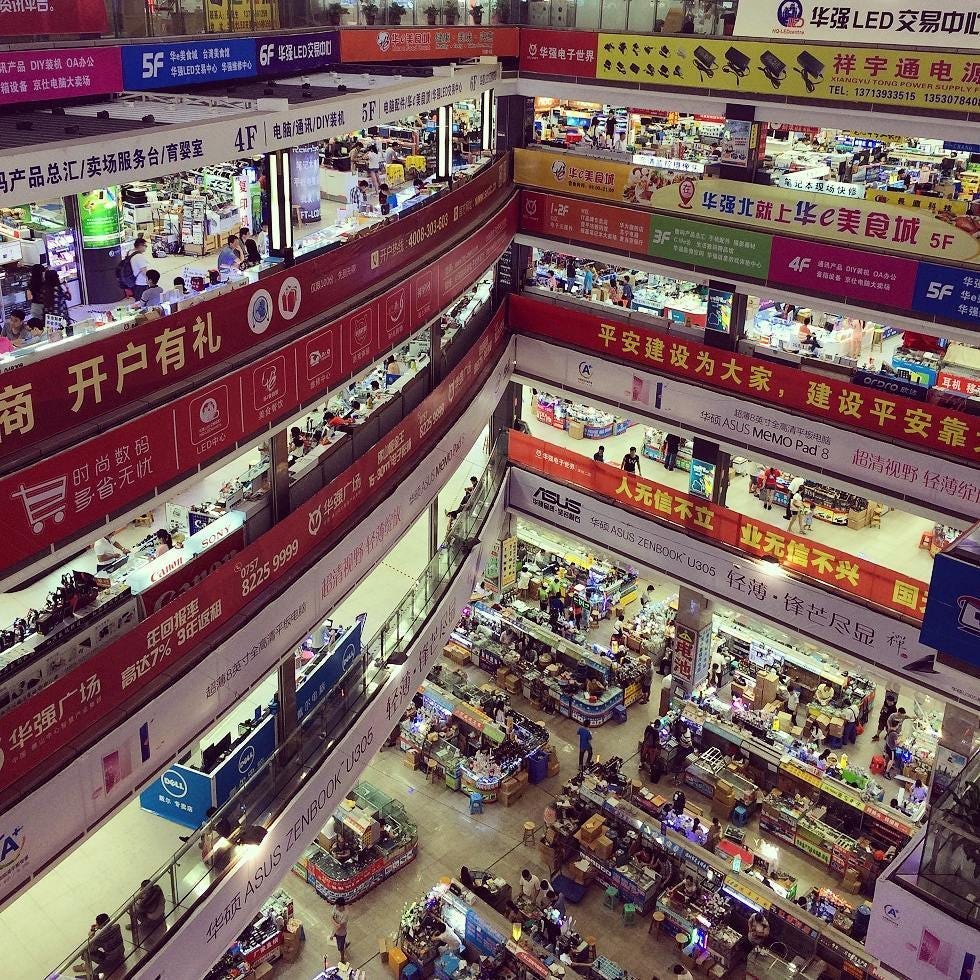
[Huanqiangbei, the world’s largest electronics marketplace / Photo credit unknown]
Motorola invented the semiconductor, ARPANET is the grandfather of the internet, and Siri wouldn’t be possible without DARPA technology. Pioneering, groundbreaking science done by people far smarter than I could ever dream of being.
When you check modern records however, China manufactured the vast majority of your consumer tech hardware, most of it likely coming from one shining city - Shenzhen, and its unending focus on speed-to-market; physical manufacturing at scale the likes of which has never been seen before.
Though China remains constrained by US semiconductor technology embargoes — particularly the inability to access ASML’s EUV lithography machines; the Dutch-built multi-million-dollar behemoths required to print the world’s most advanced chips — their domestic production capability is advancing rapidly. This remains one of the most interesting developments and something I’m watching closely. Competition here is more than welcome.
While the US market shifts more deeply into services/software (the renter model logic), China seems to double down on an “all of the above” approach, deeply rooted in manufacturing prowess and rewarding the prototype mentality, while advancing into meaningful software development.
As just one example: LLM/AI model DeepSeek and its growth show genuine promise and proof that the science behind it is sound, while the Silicon Valley business model remains badly warped towards short-term investor gains, stifling the beauty of the creation.
The biggest geopolitical problem currently is “taking one’s salad bar and going home”.
Sure, America may have invented the concept of a ‘frontier AI model’, your ChatGPT and Gemini and so on. Those are built by hyper-intelligent people standing on DARPA’s shoulders and a literal mountain range of publicly funded research.
For a while, it was the most American thing possible: messy, broadly accessible, people piling plates as high as the physics permitted with the market handing out fresh plates to whoever had a pitch that involved the letters “A” and “I”. We called it democratization of intelligence, and for a while the name was genuinely befitting. A new frontier in cooperation.
That’s before China entered the picture and got “good at it”. Not by imitating or cloning, as some suspect, but elevating in the same spirit of the cucumber-stackers at the salad bar all those years ago.
DeepSeek proved the science was sound and the model wasn’t sacred. Open-weight models began piling higher than any proprietary plate anticipated, and suddenly the frontier model wasn’t a toy that America got to pick and choose who got access. It was built by people who understood the structural limitations of the market, used intelligent thinking from other fields translated into this one, and built a better damn buffet. America’s answer to that, sadly, wasn’t to stack higher or to build a better plate, or a tastier buffet. No.
America’s answer was to restrict the market.
I’m not being smarmy, that’s where we are in geopolitics.
In June 2026, the US Commerce Department wrote to Anthropic, a private US company, and told it to stop selling access to Claude to the world because researchers in China may be able to access it and presumably do bad things with it maybe perhaps we think (trust).
Fable 5 and Mythos 5, two of the biggest and most promising models ever made, and the US government switched them off to the entire planet because someone decided the cucumber on offer was just too sweet.
This would parlay into other dealings, some involving OpenAI/GPT-5.6, seeing them reduced to staggered gated access, requiring pending approval from the US Government before allowing such access.
The government that spent 40+ years insisting that the market knew best had decided for it the instant a 2nd salad bar opened down the street. Free Market fiscal conservatives decided they’d rather play a protectionist racket than host an honest market. Here’s the thing that should piss us off more than the take-sy-back-sy: it’s pointless. You can’t take AI home the way you’d take home (read: destroy) a centrifuge or an EUV machine. You can’t un-fuck the bell, or un-ring the chicken. Whatever that saying is. You can’t call an undo, it’s not possible.
At their heart, large language models are more akin to cookbooks than centrifuges, and such things are easily transferable with minimal effort.
AI labs in China have already worked to distill frontier models like Anthropic’s Fable/Mythos, observe the reasoning, then train its own models on the bits and pieces. Washington’s response: sanctions on a company for merely learning things. Imagine that - the US Treasury, sanctioning the idea of knowledge. You can’t. Nobody has ever taken such a salad-stacker blueprint back.
The reflex says it all: If you can’t win, end the game. We didn’t stop there though, we then started hoarding ingredients. Helium. Six-nines helium, in specific. This is the purity grade of helium required to etch modern silicon and cool superconducting magnets.
The US quietly added it to the strategic materials list and squeezed exports to China down to 1/5th of what they were. Not because China was building a helium bomb, or invading New Mexico, no. Because China was beating us at our own damn game. Such behaviors are contagious, and destined for tit-for-tat. China watched us and learned the lesson perfectly.
Now, Beijing is drawing up its own export gates on frontier models - a three-tier system of who gets to think with them, and when we squeezed them out of helium, they squeezed back, banning their own exports of it. Global supply had already been dwindling, down some 40% before such back and forth. The price went from $4/m³ to $28/m³. The man who sells balloons doesn’t care who started the fight, he just knows he can’t sell balloons anymore.
That is the part that the theorem couldn’t account for. Cucumber-stackers showed us the beautiful, wholesome version: encounter a problem, understand the other guy’s plate, build a better one for everyone at the table. That’s elevation.
An uglier reflex hides within though, and both systems reach for it the moment the other gets too good: Take the salad bar, take the ingredients and plates, and ship it home. America takes Claude home with export controls and hoards helium, China volleys back by responding in kind with its own models and noble gases. Same move, mirrored across the Pacific, each dressed in their own language of security and national sovereignty.
Neither system is pure in this exchange, that’s a point I can’t help but reinforce. America built the salad bar and tried to treat it like a jealous dragon with a pile of gold. China gamed the system, and then in response gated their own off. Both are locked in a losing battle, pointing fingers and ratcheting up language/actions, while the rest of us watch on with disappointed looks.
On Metropolis
San Francisco is one of America’s wealthiest and most prominent cornerstone cities - a bedrock foundation of pop culture, deep cuts, bloody revolution, flower power, and the pervasive stench of Marin County slimebags clogging up traffic on the Bay Bridge.
I love that town. I love Oakland. I love the Bay. I love SF. I am a huge cheerleader for that town and I will be the first to tell you: It is deeply flawed, to the point of belly laughs. A quick comparison between the two tech titan enclaves, SFO and SZX (Shenzhen) will leave you stunned if you’re unfamiliar:
Shenzhen: 50-story modular tower erected in 19 days. Prefab construction, centralized planning, relentless execution. Operating currently. One of the world’s most up and coming cities.
San Francisco: 58-story ‘Millennium Tower’ built in 4 years, which immediately began sinking and leaning. The city is worth a small country’s GDP. People die on sidewalks within view of billion-dollar headquarters from sheer neglect.
San Francisco’s problem isn’t traffic, crime, bad engineering or housing costs. It’s priorities.
The dominant economic system was designed to serve capital first and foremost, at the expense of everyone else, and it has worked exactly as designed. San Francisco and its surrounding areas of Mountain View, San Jose, Santa Clara and Cupertino are home to Google, Substack, Apple, Intel, and about a thousand other Fortune 50/500 companies that own the world collectively, yet that wealth fails to trickle down to the most desperately needy, living in front of their world headquarters garage door.
The people neoliberalism left behind are not a bug: they’re a consequence of the design philosophy. The city is racked with the inefficiencies of capital-first logic, leading to horrific outcomes - people languishing on sidewalks, under tarps, in tents and old vans.
End result: SF has ~20x the per-capita homelessness of Shenzhen despite having ~8x the per-capita GDP, making this that much more insane. Roughly 1% of SF residents are listed as homeless, among the highest per-capita in US; while being one of the most prosperous cities on the planet.
Shenzhen’s problem is different though: Its growth was directed from above, which means when direction is wrong, it’s wrong at scale. The principle was different as well: stability and shelter precede prosperity. The city housed people before it made them rich. That choice shows in the outcomes.
Put this framing into your head before we go farther.
San Francisco, August 2026. A disheveled man lies on a sidewalk along the Embarcadero. He’s not there purely because of drugs or mental illness.
He’s there because the city, his country, supposedly the richest in the history of humankind — has decided by its actions that his life is not a priority worth the cost of solving, while the “rival” of its country has found something it could never: a difference in priorities.
Somewhere in the middle of tech ownership talk and fancy cars is that man on the sidewalk, wasting away in so-called Metropolis. He didn’t invent the salad bar, he didn’t stack any carrots or cucumbers, nobody offered him a plate or asked him to sit at the table with them.
The man desperately needs a plate and a seat at the table, and a nice place to lie down safely and sleep afterwards. Unfortunately, due to our priorities, such needs are rarely met. In Metropolis, the man will get no such plate, no such benefit of shared wealth or cucumbers, and will spend tonight on the sidewalk, again.
Two systems, two design philosophies
To better understand things on a granular level, let’s take a brief look at both systems side by side. I promise I’ll keep it light, lest this part drag on for centuries.
America’s Machine:
Designed by 18th-century merchants and plantation owners who feared centralized power above all else. The constitution they built is a machine optimized for gridlock as a feature, not a bug. Checks, balances, separation of powers, every lever designed to slow things down and giving the people a direct chance to stop it before it happens.
When this fails: Nothing gets done, even when everyone agrees there’s a problem. The machine is designed to require consensus, and consensus requires time, money, and the absence of bad faith actors. In 2026, all three are in short supply.
Practical example: San Francisco
City Council votes on funding for a new homeless shelter. The project unfolds, a CEQA lawsuit from the neighbors stops it dead - 2, possibly 3 years of litigation if not derailing the project entirely. Should it continue, state funding would match, but requires an environmental review and about 12 weeks of asking sociologists if the bedspreads are the right color for someone facing “housing adversity and inter-financial struggles”.
By the time federal HUD grants are taken into account, compliance requirements met, and the initial groundbreaking happens? The original funding is expired and the need has doubled - the Embarcadero encampments only grew in population during this ordeal. There are now more people desperately seeking plates of cucumber and shelter.
What this means for us: Even our most well-intentioned ideas are destined to become boondoggles, pork barrels, and long, drawn out scandals in real time. Lives hang in the balance, the desperately needy waiting to be seen. People struggle to tread water while others sink and a select few above them watch from multi-million dollar yachts.
China’s Machine:
Designed by 20th-century revolutionaries who feared chaos and fragmentation above all else. The system they built is optimized for stability and execution as the primary goal. The National People’s Congress is not designed to debate on C-SPAN — it is designed to deliver public policy. The people send their delegates to the CPC (not unlike the House or Senate) who then work to enact the change desired.
When this fails: The people at the top can make a bad call; there is no institutional mechanism to course-correct without a palace drama. The system is excellent at execution, but execution of the wrong plan is worse than no plan at all.
Practical example: The NPC sets the overarching policy of “take public money, house people with it”.
The State Council allocates said funding to the municipal governments which will identify land (which it already likely owns) to begin the design/construction stage within months. No CEQA, no zoning board, no NIMBYs, no public comment period after the draft necessary - as that was included from the first step.
This is known as “Whole-process people’s democracy”, a system of representative democracy different in practice from the more traditional European/American model.
The mechanisms are simpler: People elect local leadership for the delegation, and the chain up to the party leadership is built from that delegate - selecting other “sub-delegates”; representatives in turn to work as functionaries, operators that the local delegates rely on and who (through job performance) answer to the local delegates, and in turn the people.
Contrasted:
- Both systems are rational responses to their founding conditions.
- Both have failure modes that are mirror images of each other.
- America’s strength is its ability to self-correct slowly; its weakness is that “slowly” increasingly means “too late” or “not at all”.
- China’s strength is its ability to execute rapidly; its weakness is that “rapidly” increasingly means “without enough input.”
Neither is perfect, both have blind spots and parts to make a man furious sometimes, but they each have strengths that can be learned from.
The Guy on the Sidewalk

[A man eats a meal in a back alley of Shenzhen’s less scenic areas - photo credit: Derek Galon/fivehundredpx]
Shenzhen’s poorest neighborhoods lack the glamour of its skyline, sure, but people live indoors. They eat regular meals. The city government considers basics like food and shelter a non-negotiable line item, not a market problem to be solved by invisible hands.
This is not a moral judgment, but a difference in priorities - one system decided that the market’s greed was more important than basic human dignity: shelter, health, food, basic quality of life.
This is THE observation about systemic priorities. America’s system allocates resources toward the generation of private wealth first, China’s system allocates resources toward the maintenance of public stability first.
Both have trade-offs, the man on the sidewalk is the trade-off America chose.
It’s worth asking whether that was the correct decision, as it stands I just don’t believe it was, is, or ever should be. Life, be it the birds in the trees, the humans in the streets, the emergent life we have yet to quantify and put in our neat little classifying headers is precious. It should not be treated lightly, with such indifference.
While you were reading this, the seasons changed. Birds migrated, the sun moved a bit. It’s now winter 2026. The man on the Embarcadero from earlier in the piece is gone, his life ending on that very sidewalk sometime in the summer; not from heat or drugs, not from bad choices or crime, but callous indifference. A difference in priority.
His passing will not make news headlines, no long-winded eulogies will be written for him. The best he can expect is a quiet, dignified cremation and prayer, his ashes spread in the waters of the Bay; scattered by a small team forced to watch this cycle repeat time and time again. Callous indifference, death, unclaimed bodies cremated, a life forgotten, a story written no longer able to be told. All because of priorities.
Both systems have their failure modes, quirks, shortcomings and pratfalls. I’m not attempting to be a salesman of any side, but it is always good to see what others are able to achieve when I come up short.
America’s failure is that the man dies because no one was responsible for keeping him alive. China’s failure is that if the leadership decides the wrong priority, that wrong priority gets executed at scale.
Nobody’s Perfect, But We Can All Learn
The man is dead. It’s 2027. The birds are still singing, the sun still rises over the Embarcadero, and the next man is already lying on the same sidewalk. Nothing changed, but something should have. Let’s be practical:
On building before the crisis: Shenzhen’s metro wasn’t built because traffic was unbearable. It was built because someone in 1985 looked at a map of underdeveloped rice paddies and said: “People will live here. Let’s put the tracks down first.”
Anytown USA does the opposite. Your city waits until the school is overcrowded to build a new one. Waits until the bridge collapses to repair it. Waits until the homeless encampment is a public health crisis to fund shelters. The principle is simple, and you already know it: buy the land when it’s cheap. Pass the bond when the need is visible but not yet desperate.
Your city council won’t do it because there’s no political reward for preventing a crisis that hasn’t happened yet. That’s not a budgeting problem. That’s a time horizon problem.
On stability as a prerequisite: Shenzhen’s poorest neighborhoods aren’t glamorous, but people live indoors. The city government considers basic shelter a line item, not a market problem. It’s not charity, it’s an operational assumption: a housed person is cheaper to govern and has higher productivity than an unhoused one.
Anytown USA spends more on emergency room visits for the unhoused than it would cost to house them. More on police calls to encampments than it would cost to fund shelters. More on jail beds than on rent assistance.
The math isn’t complicated. The incentives are just pointed in the wrong direction. Your mayor knows this. Your city council knows this. The reason it doesn’t change is that the cost of not solving it is distributed across a dozen different budgets, none of which are accountable to the same person.
On long-term planning: The American planning horizon is 2-4 years: one election cycle, one quarterly earnings report. China’s planning horizon is 10-25 years, the length of a Five-Year Plan, the lifespan of a generation of leadership.
Anytown USA can’t fix its time horizon overnight, but it can start small: a 10-year capital improvement plan that actually gets followed. A zoning code that looks 20 years ahead instead of reacting to the last lawsuit. A housing bond that funds construction for a decade instead of a single project. The tools exist. What’s missing is the will to use them for something beyond the next election.
What China could learn from the US system: The man on the sidewalk might not have died in Shenzhen or Guangzhou, but if the CPC decides tomorrow that homeless people are a “visual blight” to be cleared before an international conference, they’ll be cleared quickly, efficiently, and without public debate. That’s the other failure mode. Speed without input is tyranny with good infrastructure.
China’s system needs a piece of what America’s system has, even in its broken form: mechanisms for dissent that don’t require a palace coup. A journalist who can ask a hard question without being disappeared. A local official who can say “this policy is wrong for my district” without ending their career. A public record of who decided what and why. Accountability in a more transparent form.
The synthesis: The man on the sidewalk didn’t need a violent revolution or a bloody coup. He needed a city that could build housing in less time than it takes to litigate a CEQA challenge. He needed a health system that treated his existence as a cost worth bearing. He needed a political system where someone, somewhere, was responsible for the outcome - someone that gave a damn and had to answer for his well-being. That man needed something that doesn’t quite exist yet, but ought to.
China builds faster. America argues better. The man needed both: a system that could act, and a system that could be held accountable when it acted wrong. Neither country has yet to solve that equation, but the first step is admitting that the other guy’s toolbox has tools yours doesn’t.
The end (no judgment, just a question)
On a map, Shanghai and New York could be siblings. Same latitude, same relationship to the ocean, same skylines pierced by ambition.
Yet: one city was built by people who believed the future belonged to whoever built it fastest and most systematically, and the other by people who believed the future belonged to whoever argued about it most carefully and kept the lights on for the least of their citizens first.
While neither system has solved the problem of human greed, corruption, or indifference, they are both trying through radically different machinery to answer the same question: how do we live together without destroying each other or the planet in the process?
History books show plainly that even the most righteous revolutions end in a bloody mess, their ideals crushed by the very machinery built to defend them. The answer is not conquest. The answer is not surrender.
The answer, perhaps, is the same one the Chinese cucumber-stackers found at the Pizza Hut salad bar thirty years ago: encounter a problem, look at what the other guy built, understand why it works, and figure out how to do it better — not to beat them, but to improve the meal for everyone at the table.
– RS