

Dearest reader,
Surely you’ve seen the news, the Nation’s 250th anniversary “modifications” to the Lincoln Memorial Reflecting Pool. The hastily applied spray-liner, the algae filled waters, the hydrogen peroxide, the dead ducks, the arrests, and the stench.
There is a specific kind of stupidity that only a failed bureaucracy can achieve: the kind where you spend $14 million on a renovation, watch it fail in less than two weeks, pour caustic chemicals into it, blame vandals, and then arrest a 67-year-old Olympian for touching the evidence of your incompetence.
This is not a metaphor. This happened on a Saturday in June, in Washington, D.C., at the foot of the Lincoln Memorial.
It’s too stupid a story to pass up for yours truly, so let’s take a deep dive into the shallow, murky waters of the damn thing. Please be aware: this story is unfolding in real time, and doesn’t have a clear conclusion beyond the anticipated “they’re a bunch of clueless idiots” soft-landing. This is just a series of reflections on the situation, how it came to be, so on.
On with it as always.
Reflecting
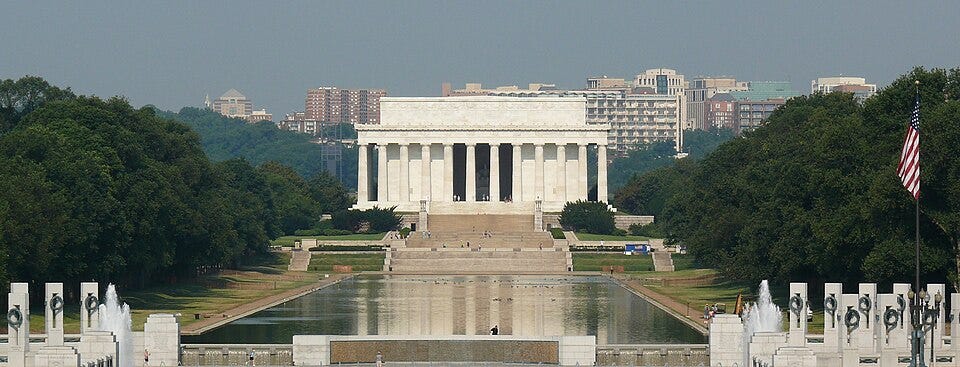
(The Reflecting Pool and the Lincoln Memorial / Photo credit: Ad Meskens via Wikimedia)
Built in 1922, the Lincoln Memorial Reflecting Pool is a massive rectangular basin stretching roughly 2030~ feet in length, 167 feet wide, holding about 6,750,000 gallons of water. The depth slopes gently from 18 inches at the edges to just 30 inches in the middle. A shallow puddle in the grand scheme of things, but a grand work of design, laid carefully on the marshy DC lands.
The structure, with its original tile/asphalt bottom, would not last long unchanged. By 1929 and into the 1930s, the basin would receive a reinforced concrete slab foundation and drainage trenches along the elm walks. This would survive decades until 1981, when a full renovation would attempt to solve water leakage, but structural issues persisted; and on top of that algae blooms were a constant problem from the 1920s start onwards.
In 2009, a major reconstruction costing some $34,000,000 would take place, happening over roughly 3 years. The pool was elevated, pilings added to stop further sinking into the marshlands, and water circulation/filtration was added to further bring the marvel up to modern standards.
During the 2009-2012 renovations, a waterproofing was added, and the concrete was tinted a neutral gray. This renovation saw more algae blooms, something that (at the time) was seen as a non-event, a trivial annoyance to filter away. These renovations would sustain largely unchanged for another 14 years.
This would change in preparation for the nation’s 250th anniversary, seeing the pool drained, hastily sprayed with a “flexible coating/sealant” in a dark blue color, and refilled.
If you’ve ever painted brick with latex paint, you should know how badly this is about to work. Now add in “dark colors retain heat, and heat makes algae bloom faster”. I don’t need to tell you what came next, but there are some key moments worth visiting while it unfolds.
Bethesda’s Best

(Photo of David Hearn in his element, competing for Team USA in the Sydney 2000 games / Photo credit: David Madison via Getty Images w/a million thanks)
By June 20th, the newly sprayed liner was in tatters. Becoming an international news story, with people coming from around the nation to gawk at the latest Trumpian disaster - the result of a no-bid contract worth roughly $14,000,000-$16,000,000. The contract, awarded to a man who had previously worked on a Trump golf course swimming pool, was executed on a compacted timeline. It would take mere days to drain, spray, and refill the reflecting pool. A nice, Michael Eisner-approved cheap coat of paint on an aging theme park attraction.
Enter David Hearn, aka “Davey”. Davey is a 67 year old Bethesda MD native and 3-time Olympian, two-time World Champion and 12x medalist, as well as other accolades - an all around highly established man, highly familiar with kayaking and watercraft. The man knows the Potomac like few do, in a personal and deeply interconnected sense, given it is his home.
Post-athletic career, Davey has owned and operated a specialized business supplying composite materials, resins and custom parts used to build high-performance whitewater watercraft; giving him unique insights into materials science as well as marine polymers and industrial coatings.
With his technical expertise, and driven by his natural curiosity, Davey would take a 52-ish mile bike ride from Bethesda to the DC Mall, a journey likely similar to one he took many times before. Arriving at the Mall, Davey made his way directly to the scene of the situation, and reached into the murky waters just to feel the coating, to understand the materials at play perhaps, to further inform himself on the topic, quite possibly the most qualified man within a hundred miles to assess the situation.
Before he finished processing the sensations on his skin, he was placed under arrest by the US Park Police on a misdemeanor charge of ‘destruction of government property’, for the crime of merely touching the already-detached liner.
Hearn didn’t just “touch it” out of idle curiosity.
He owned and operated a specialized business supplying composite materials, resins, and custom parts for high-performance whitewater watercraft. He spent his career working with industrial coatings and marine polymers. He saw a failing water-related coating job on the news, one he knew was applied by a no-bid contractor at a cost of $14.2M to the taxpayer, and rode 52 miles to go look at it. Up close. With his hands.
Because that’s what you do when your entire professional life has been spent partly “just doing”, partly understanding why materials fail.
For that crime, Davey was arrested and later released.
Before he had been arrested though, Trump was already seeding the idea that the damage was caused by vandalism, calling the failure a crime rather than a workmanship issue.
They had just arrested and scapegoated one of the best-informed people in the DMV region - Washington DC - someone incredibly yet tangentially qualified to diagnose the problem.
This piece is a story about what happens when the official narrative meets physical reality. The pool didn’t care about the press release. The algae didn’t read Truth Social. The liner peeled because it was the wrong material for the job, and the man who could have understood why was handcuffed for daring to touch it.
RINO-liner
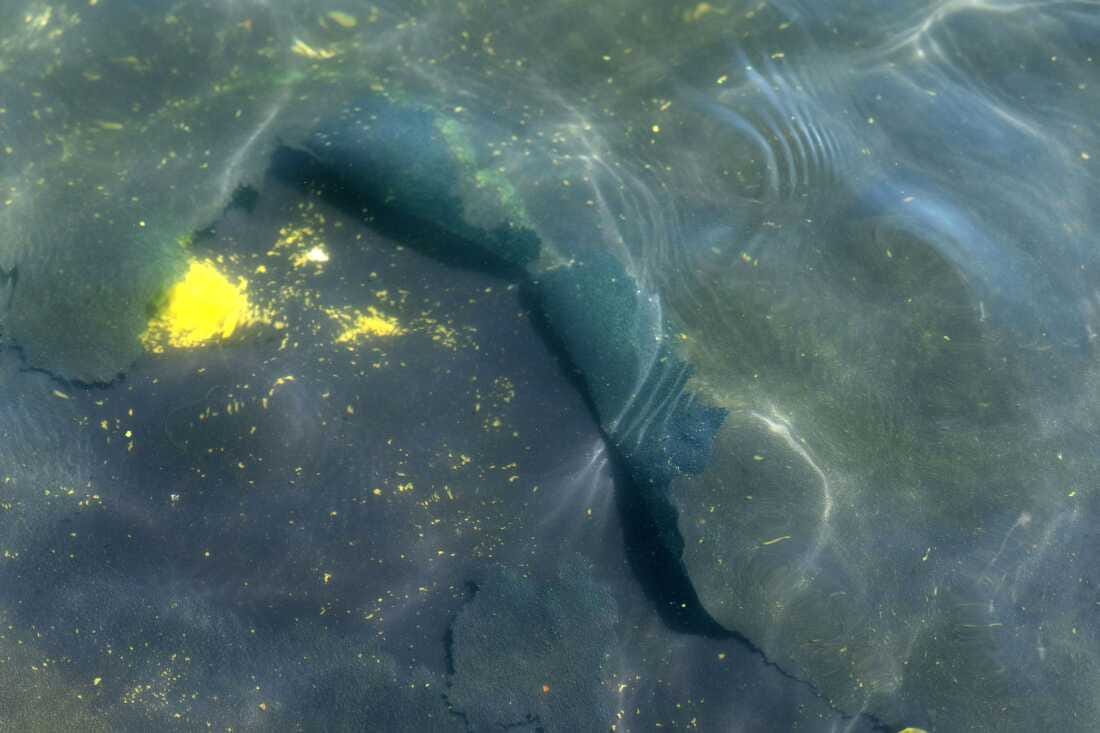
(The liner in question, floating in the murky waters / Photo credit: Mark Schiefelbein/AP)
So what the fuck is this liner? As far as I can tell, it’s a spray-on pickup truck bed liner, it’s “Rhino Liner”, but .. RINO-liner. The material composition appears to be polyurea-based per the contract, which is not designed for constant submersion. The color, ‘American Flag Blue’, was chosen for political optics and visual quality, not strictly the task at hand.
Then there’s the whole problem of “painting stone”, which itself is a tricky business - as I alluded to with my latex paint and brick quip, it’s not as easy as coating metal, drywall or wood. Stone is porous, it retains water, and water can also wick back out. It’s textured - not smooth. It is made of tiny grains of rock compressed together.
This two-way street of water flowing and water removing and water at the bottom of the ocean is dangerous business if you want a coating to stick properly to porous, uneven particles.
While the contractor Atlantic Industrial Coatings remains tight lipped about the full details, the contract does stipulate that the coating must come from “Rhino Linings”, a materials manufacturer best known for its pickup truck bed liners. This is all the confirmation this author needs - it’s RINO liner. This is a “scratch my back and I’ll scratch yours”-type cheesy mob boss deal: Trump handed a cushy contract to a friend using an already-approved material vendor, his friend rushed it because “fuck it, who cares”, and this is the end result.
At the same time, a $1,700,000 no-bid contract was given to Green Water Solutions to install a “nano bubble” filtration system, something being used to purify the water and suppress the algae blooms plaguing the blue lining.
This is presumed to be yet another RINO pocket liner, the company Green Water Solutions has ties to John Cafaro, a long-time Trump contributor who happens to live just a mile from Mar-a-Lago in Palm Beach. Suffice to say the nano bubbles are another case of “right job, wrong tool”. Without additional circulation and filtration, even ozone treatment is working beyond its capabilities as a tool - like asking ChatGPT to pick targets in Iran to point weapons at.
A CVS Trip, Dead Ducks, and the Chemistry of a $16+ Million Mistake
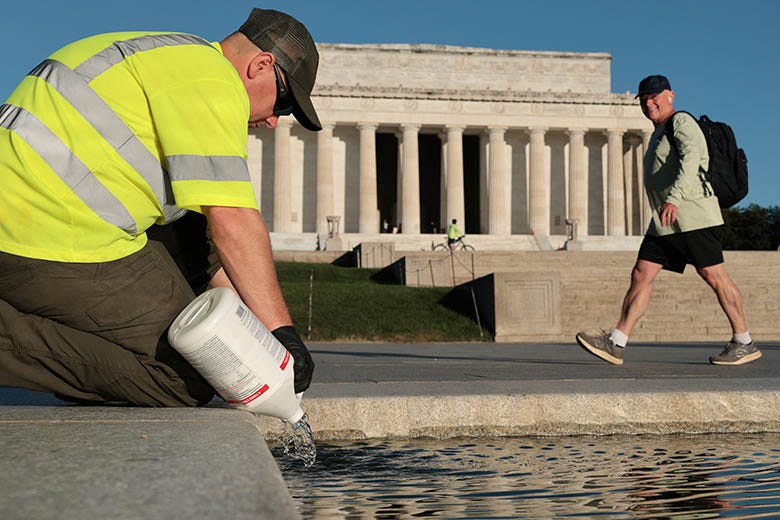
(A US National Parks employee adds hydrogen peroxide into the Reflecting Pool / Photo credit: Jonathan Ernst/Reuters)
This is where the story stops being a cute farce and starts being a legit crime scene. Not a crime of malice (strictly), but a crime of competence - or rather, the total absence of it, callous stupidity.
Let’s walk through what actually happened to that pool, because it’s a doozy when you pull up to 40,000 feet and get a clear picture of it all.
They chose the wrong material for the job
Polyurea is a spray-on polymer — tough, flexible, cures in seconds. Great for protecting a pickup truck bed from gravel and shovel blades. Not designed for constant submersion.
The chemistry is straightforward: polyurea forms urea linkages (-NH-CO-NH-) that slowly hydrolyze in the presence of water. The polymer chains literally break apart over time when kept wet.
In a truck bed that gets rained on and hosed out? Fine, harmless even. In 6.75 million gallons of water, 24 hours a day, 365 days a year? The coating was structurally overwhelmed from moisture from the moment they filled the pool.
They then applied it to the worst possible substrate
The Reflecting Pool sits on the hallowed grounds of the District of Columbia National Mall — which is, and always has been, DRAINED SWAMPLAND. The concrete bottom of the pool is porous, meaning that groundwater wicks up through it by capillary action.
When you spray polyurea onto even mildly damp concrete, the isocyanate component reacts with the moisture *during cure* and produces CO₂ gas. You get a foamy, bubble-riddled slurry where the coating never fully bonded to the stone. It looks solid from above, like a hard shell candy coating, but has the adhesion of an internally melted M&M.
Polyurea is incredibly good at keeping water in (positive pressure resistance, think a pool liner), but is terrible at resisting water pushing up from the material it is bonding to (hydrostatic pressure resistance, think a pool liner with water trapped under it).
The pool was then filled again - now you have water pressure pushing down from above and moisture vapor pushing up from below. This creates something called osmotic blistering — water migrates through the concrete, collects at the bond line of the liner, and lifts the coating off of the stone from underneath.
Antifa didn’t peel it from the top. It lifted from the bottom up, the tension/friction of water moving or merely touching it is causing it to “break apart”.
They colored it dark blue, in direct sun, in June
“American Flag Blue” sounds great in a news headline, but in reality it is a heat sponge. There’s a reason most airlines paint their planes a bright color - most going for white on top.
A dark surface, even in a shallow pool 30 inches deep at most, absorbs far more solar radiation than the old neutral gray or any other lighter color. The water temperature in that pool is running measurably higher than ambient just on basic laws of thermodynamics - every 10°C (~18°F) increase doubles the rate of hydrolysis. The pool was actively cooking its own liner from the first day - cooking long before a single drop of water was added.
The UV light? It penetrates even clear water down to several feet. Anyone who’s gotten sunburn while swimming in a backyard pool understands this is true and painful.
The entire floor of that pool is getting direct solar UV bombardment. Polyurea is notoriously UV-unstable without expensive stabilizers — the polymer chain photo-degrades, embrittles, and micro-fractures. Those cracks expose fresh surface area to more water, more hydrolysis, more failure. The proverbial dam eventually breaks.
The liner started failing within days - then they made it worse
By the time the algae had bloomed, accelerated by the now warmer, darker, nutrient-rich waters? The liner was de-laminating. The algae was a symptom, not the disease, but the administration saw green water and panicked.
Enter the National Park Service, waders on, jugs of 12% hydrogen peroxide in hand. Hydrogen peroxide at this concentration is an industrial oxidizer. At 30-35% it’s classified as a hazardous material.
When H₂O₂ breaks down, accelerated by heat, UV rays, and metal ions (which concrete and old pipework provide in abundance), it produces hydroxyl radicals (•OH). These are among the most powerful oxidizers known to chemistry. They tear hydrogen atoms off polymer chains, causing chain scission — the molecular backbone of the polyurea literally breaks into fragments.
The CDC, asked about 12% hydrogen peroxide, warned it “can cause problems if inhaled and burns if the chemical touches the skin.” They describe it as a “powerful oxidizing agent that can cause spontaneous combustion when it contacts organic material.” We poured it into a national monument.
Here’s the kicker: That was already bad, but they didn’t pour enough to do the job.
Dr. Michael O’Brien, a DC pediatrician who apparently understands basic chemistry better than the entire National Park Service, calculated that you would need a minimum of 8,000 liters of 12% hydrogen peroxide to reach the 50 parts per million concentration needed to kill algae in 6.75 million gallons of water. They poured a few jugs. A fraction of what was needed. Into a stagnant basin with no circulation.
The peroxide didn’t kill the algae. What it did do was concentrate in undiluted pockets, hotspots of 12% solution sitting on the already-failing polyurea surface, attacking the polymer at a molecular level. The same oxidation reaction that breaks down algae also breaks down the liner - a final de-bonding, a chemical “explosive charge” inside the pre-existing cracks.
Hydrogen peroxide is highly unstable and rapidly decomposes into water and oxygen gas (O2) when it encounters a catalyst (2H2O2 -> 2H2O + O2). The algae blooms and concrete minerals act as “severe catalysts” for the decomposition.
When NatParksSvc poured the concentrated hydrogen peroxide into the water directly, the heavy, dense solution sank to the bottom immediately. It seeped into the micro-cracks and osmotic blisters in the liner. Once inside, the peroxide decomposed into oxygen gas - the volume expansion of trapped gas blew the already-weakened polyurea off the substrate from the inside out, tearing the liner into the floating chunks/sheets seen in so many videos.
The coating didn’t just peel away because someone touched it - it was chemically disassembled and then exploded, from the inside out.
The duck died twice, maybe even a third time
The dead duckling found floating in the pool on June 21st has been treated as a tragic side note - it’s not. It’s the canary in the $16+ million coal mine; though official cause of death has yet to be determined, the plausible explanations are all indictments of the same system.
Maybe the duck swam through an undiluted pocket of 12% hydrogen peroxide: a caustic hotspot that burned its skin or caused systemic toxicity when ingested. The CDC says 12% solution causes burns on contact and respiratory damage if inhaled. A duck doesn’t know to avoid the clear spot where the chemical concentrate settled.
Maybe it was cyanobacteria. The same warm, stagnant, nutrient-rich water that bred the algae bloom also breeds cyanobacteria, which produces microcystins, a group of potent liver toxins. An expert told the Washington Examiner the pool “could have signs of cyanobacteria.” The algae treatment didn’t work because they used the wrong dose, and the cyanobacteria kept blooming unchecked.
Or maybe — and this is the one that normally would keep someone up at night — the duck died from the chemical soup created by the degrading polyurea itself.
When polyurea breaks down through hydrolysis and oxidative attack, it releases residual isocyanates, polymer fragments (oligomers), and other breakdown products into the water. These are documented aquatic toxicants. The pool wasn’t just painted. It was chemically active. Every square foot of failing liner was leaching synthetic compounds into a stagnant basin with no outflow, no filtration, and no testing.
The duck didn’t die from one thing. It didn’t have to - it died from everything. The algae, the chemicals, the heat, the stagnation, the total absence of anyone in charge asking “what is this doing to the living things in this water?”
That’s the real crime. Not that they failed, everyone fails sometimes. It’s that they failed by design, by choosing the cheap, fast, politically expedient option, and then blamed the consequences on vandals, socialists, and a 67-year-old kayaker who was visiting on a bicycle.
The Stench
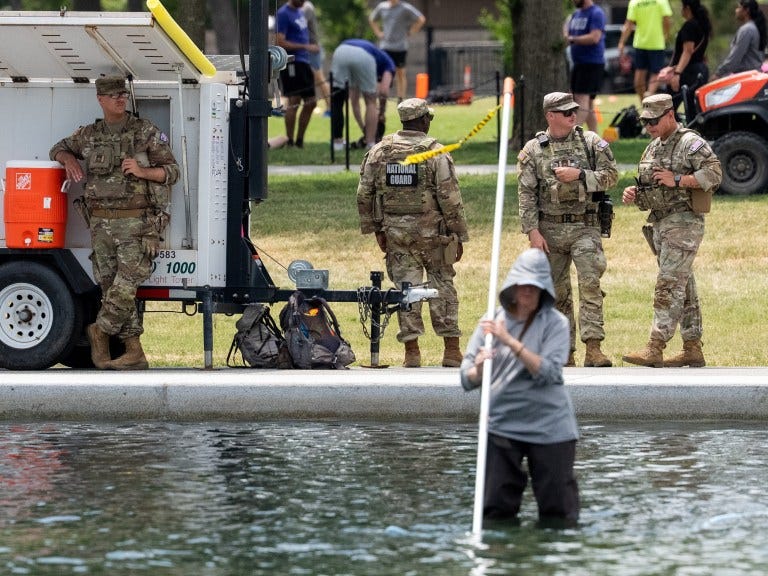
(The National Guard stands nearby as the Reflecting Pool is swept by hand, June 22, 2026 / Photo credit: Mark Schiefelbein / Reuters)
The pool is being drained now and prepped for a redux. As I write this, DC photographer Joe Flood is posting photos of the operation on X, captioning them: ”As they drain it, the Reflecting Pool is starting to smell.”
OF COURSE IT IS! That stench is the smell of 6.75 million gallons of stagnant, chemically-treated, algae-choked, liner-leaching sludge being pulled out of a concrete basin that’s been cooking in the June sun for weeks. It’s the smell of a $14.2 million no-bid contract turning into a National Guard deployment. It’s the smell of a government that has lost the ability to do the boring, competent work of governance: the work of engineering, and has replaced it entirely with protecting the ego of one man, one office, one reputation.
The stench is not a metaphor, it’s an air quality event. Workers are in waders standing in a chemical soup, forced to breathe whatever off-gases the peroxide and the degraded polymer are releasing. Nobody is testing the air. Nobody is testing the water. Nobody bothered to ask the question.
The National Guard is standing guard, armed patrols, over a puddle that smells like rot; guarding the evidence of incompetence from we the people, fully qualified to explain it.
Honest Abe watches on, waiting for someone to challenge him for the title of “Honest”.
The Mirror Back at Us
This pool is not a one-off. It’s a microcosm, a poster child to point to. Every systems failure in the modern American government follows the same pattern: fail to plan long-term, choose the fast option, skip the expertise, blame the outcome on enemies, and arrest the whistleblower.
The Reflecting Pool is just the latest example, a visible, tangible, *smell-able* case study in how the administrative state has rotted from within.
The pool didn’t fail because of vandals, it failed because nobody in the chain of command understood materials science. It failed because the contractor was chosen for his connections, not his qualifications. It failed because the color was a political statement, not an engineering decision. It failed because they poured industrial chemicals into a public water feature without calculating the dose or considering the wildlife.
It failed because the man most qualified to diagnose the problem was handcuffed merely for touching the evidence - and now there’s a National Guard presence at the Lincoln Memorial Reflecting Pool, treating it like an actual crime scene, just not the crime they’re investigating.
Think about that sentence. Really sit with it. Armed military personnel, deployed to protect a coat of pickup truck bed liner that someone hastily sprayed onto a concrete basin built on a swamp, because the contractor didn’t know what he was doing and the President can’t admit he was wrong.
This is not a bug. This is THE feature. THIS is what governance looks like when it’s been hollowed out to a shell — all optics, no substance, all blame, no accountability.
The pool is green. The RINO-liner is peeling, the ducks are dying. The National Guard is standing watch, and Davey Hearn — three-time Olympian, materials expert, 67 years old, bicycle commuter — is the most dangerous man in Washington DC: because he understood what was happening before anyone in charge did.
They arrested him for that.
And the pool still won’t be blue in time for July 4th.
– RS
I love the detail in this. I am curious what the water table level is there and would it fluctuate with the tide or intense rainfall. I would like to blame the Swamp for pushing the liner up from below, but don't know if that's science.
Thx for the Chem lessons